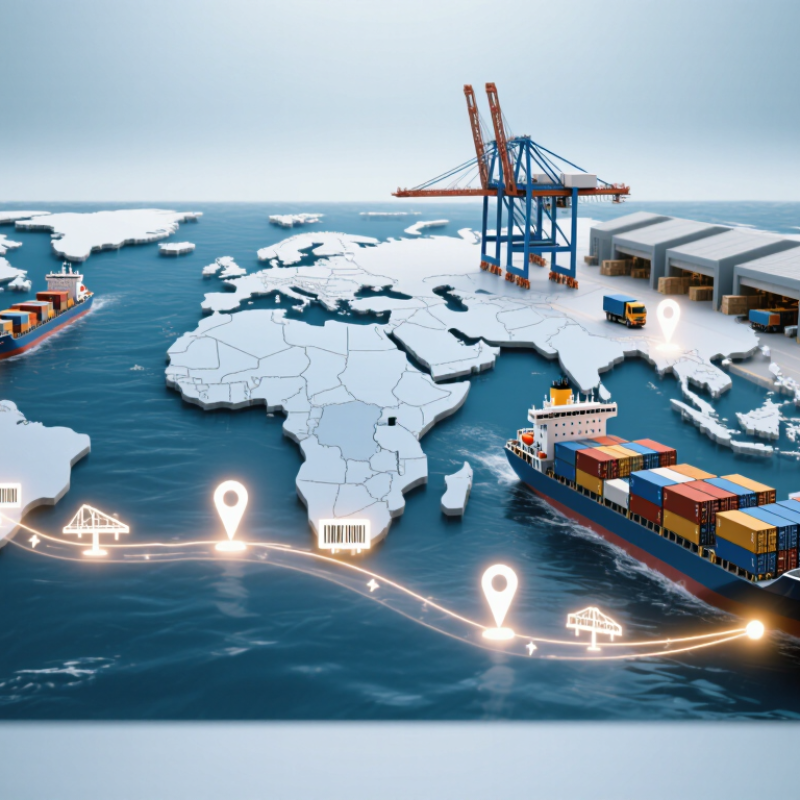
Global shipments rarely move in a straight line. A carton may leave a factory in Shenzhen, cross an ocean, pass through a port, and arrive at a warehouse in Rotterdam. Each handoff creates new information—and a chance for delay. So, how does logistics tracking system work globally? It connects shipment records, location updates, and status messages from carriers, ports, warehouses, and delivery teams.
MIT supply-chain expert Yossi Sheffi has emphasized that visibility helps organizations respond to disruption. In practice, that means more than placing a dot on a map. A tracking platform may combine GPS data, barcode scans, electronic shipping documents, and carrier updates. When a container is scanned at a terminal, its event can update the shipment timeline. If a vessel arrives late, teams can adjust receiving plans or notify customers. Small details matter.
But tracking is not magic. Some updates arrive late, and systems may use different data formats. A dashboard can look precise while missing a handoff scan. That is why dependable global tracking relies on clear identifiers, regular data checks, and communication between partners—not software alone. For readers asking how does logistics tracking system work globally, this guide will explain the signals, systems, and people behind each update. It will also examine what tracking can show, where its limits remain, and how businesses can use shipment information without mistaking estimates for certainty.
Assign Each Logistics Unit a GS1 SSCC Identifier
Global logistics tracking works best when each physical logistics unit has a persistent identity. The GS1 Serial Shipping Container Code (SSCC) identifies a pallet, parcel, or grouped load. It contains 18 digits and is assigned by the party creating the unit. The code can appear in a GS1-128 barcode or on an RFID tag. At dispatch, a scan connects the SSCC with shipment details, contents, destination, and time. Scans at hubs and delivery points add movement events, giving teams a record of where the unit was handled.
Reliable tracking depends on disciplined scanning and clean data. MHI’s 2024 Annual Industry Report found that 55% of respondents planned to increase investment in supply-chain innovation over the following five years. But new technology cannot fix a duplicate code or a missed scan. Each logistics unit needs its own valid SSCC, and the label must remain readable during handling. In practice, labels get covered, and rebuilt pallets can lose their tracking link. That weak point deserves attention.
Tips: Print the SSCC in a clear, scannable area. Scan it when the unit is created, transferred, and received. If a pallet is rebuilt, record the change and assign the new unit its own identifier. Small checks matter. A barcode that scans once is not proof that every handoff was recorded.
Capture Scan, RFID, and GPS Events at Every Handoff
How Does Global Logistics Tracking Work?
A shipment’s location is built from small events, not one continuous view. At a warehouse exit, a worker scans a label and records the time, place, and shipment ID. At busy docks, RFID readers can capture several tagged cartons as they pass through a doorway. Each method has limits: a missed scan or poorly positioned tag can leave a gap.
At a transfer point, such as a port terminal or regional hub, the next handoff should create another event. GPS adds location and movement data while a vehicle is in transit; it does not confirm that a specific carton was loaded or unloaded. Linking these records lets teams compare custody changes with route progress. Small details matter. A scan tied to the wrong shipment can make a precise timeline misleading.
Reliable tracking depends on consistent procedures. Staff need clear scan points, working readers, and a way to flag damaged labels or unexpected delays. Systems should preserve event times and identify where each record came from. Not every signal arrives. GPS may be blocked indoors, while network delays can make an event appear late. The record is useful, but it is not the physical shipment itself. Reviewing exceptions and checking handoff records helps reveal what the data cannot.
How Does Global Logistics Tracking Work? - Capture Scan, RFID, and GPS Events at Every Handoff
Representative shipment event sequence. The example values are illustrative; timestamps are normalized to UTC. Scan, RFID, GPS, and system-generated events may be combined to maintain a shipment history across handoffs.
| Event Time (UTC) |
Handoff or Milestone |
Location |
Capture Method |
Typical Data Captured |
Tracking Status |
| 2025-04-08 01:15 |
Shipment collected from shipper |
Shenzhen, China |
Barcode scan |
Shipment ID, package ID, scan time, collection point, and handling-unit association |
Picked up |
| 2025-04-08 03:40 |
Received at origin consolidation facility |
Shenzhen, China |
RFID portal read |
RFID tag identifier, reader or portal ID, read time, and facility zone |
Received at facility |
| 2025-04-08 06:05 |
Vehicle departed for export port |
Shenzhen, China |
Vehicle GPS |
Device time, latitude and longitude, vehicle movement, and linked shipment or container reference |
In transit to port |
| 2025-04-08 07:22 |
Vehicle arrived at port interchange |
Yantian, China |
GPS geofence event and terminal gate record |
Geofence entry time, approximate position, gate-in time, and transport-unit reference |
Arrived at export port |
| 2025-04-08 09:10 |
Export terminal accepted container |
Yantian, China |
Gate scan and terminal system event |
Container number, terminal location, gate transaction, event time, and booking reference |
Received at terminal |
| 2025-04-10 16:30 |
Container loaded for ocean departure |
Yantian, China |
Terminal loading event |
Container number, vessel or voyage reference, load confirmation, and event time |
Loaded for export |
| 2025-04-24 08:00 |
Vessel arrival recorded |
Rotterdam, Netherlands |
Port or carrier system event |
Arrival time, voyage reference, port call, and container association |
Arrived at destination port |
| 2025-04-25 11:45 |
Import release confirmed |
Rotterdam, Netherlands |
Customs or logistics system update |
Release status, declaration reference, update time, and any outstanding hold indicator |
Released for onward movement |
| 2025-04-26 06:20 |
Shipment sorted for final delivery |
Rotterdam, Netherlands |
Barcode scan |
Package ID, facility and sort location, scan time, and delivery-route assignment |
At destination facility |
| 2025-04-26 13:35 |
Delivery completed |
Rotterdam, Netherlands |
Delivery scan and proof of delivery |
Delivery time, recipient or delivery-point confirmation, and proof-of-delivery reference |
Delivered |
Track Ocean Shipments: UNCTAD Says Sea Carries Over 80% of Trade by Volume
UNCTAD estimates that over 80% of world trade by volume travels by sea. That scale makes ocean tracking more than a map with a moving dot. A shipment may pass through a factory gate, a loading terminal, several ports, and a final warehouse. Each handoff creates a new event, and each event can arrive late or incomplete.
Tracking usually combines shipment records with vessel-position data and port updates. A container number links cargo to milestones such as gate-in, loading, departure, transshipment, and discharge. AIS signals can show a ship’s position, but they do not prove that a specific container is aboard. Terminal scans and carrier notices help fill that gap. Weather, congestion, schedule changes, and missed data feeds can shift an estimated arrival. Quiet sometimes. That does not always mean the cargo has stopped moving. Teams should compare timestamps, location, and the last confirmed handoff before changing plans. A practical tracker makes uncertainty visible, rather than presenting every estimate as a promise. One weak spot remains: data can look clean while the underlying milestone is stale. A buffer still matters, because the ocean rarely follows a perfect timetable.
How Global Logistics Tracking Connects to Ocean Freight
The scale of seaborne trade makes shipment visibility an important part of global logistics.
UNCTAD reports that over 80% of global trade by volume and more than 70% by value is carried by sea. The bars show these reported minimum thresholds; actual shares are higher. Ocean shipment tracking uses status updates across key transport stages to help businesses monitor cargo movement.
Source: UN Trade and Development (UNCTAD), Review of Maritime Transport.
Share Standardized Events Through GS1 EPCIS 2.0 and Partner APIs
A shipment generates many small signals: a pallet is packed, a container is loaded, or a truck reaches a depot. Global tracking becomes useful when partners can interpret those signals consistently. GS1 EPCIS 2.0 provides a shared structure for describing supply-chain events, including what moved, when it moved, where it was, and why the event occurred. An event might show that a labeled carton left a cold-storage facility at 06:40, with its temperature recorded at handoff.
Consistency matters. One partner’s “dispatched” status may mean a label was printed; another’s may mean the vehicle actually departed. EPCIS event details help reduce that ambiguity. Partner APIs then connect systems, allowing approved event data to move between a shipper, carrier, warehouse, and receiver without manual re-entry. Clear field mappings and access controls help keep updates useful and appropriately limited. Small details matter.
Still, shared standards do not guarantee perfect data. A missed scan, delayed connection, or incorrect location can leave a shipment timeline incomplete. Teams should test API exchanges with real operating scenarios, including late arrivals and corrected events. That work takes patience. Even a well-designed system can expose gaps in partner processes, which is uncomfortable but useful. Reliable tracking depends on both sound technology and people who review exceptions instead of treating every status as certain.
Use Timestamped Data to Estimate Arrivals and Flag Delays
Global logistics tracking turns timestamped events into a moving picture of a shipment’s journey. A pickup scan at 08:12, a terminal arrival at 14:46, and a vessel departure at 23:10 show when custody changed. Comparing actual events with planned milestones helps estimate arrival windows, not promise an exact minute. A container that misses a port cutoff may lose its planned sailing. The updated forecast should reflect that gap. Small details matter.
Useful tracking systems weigh event time, location, source, and expected route sequence. They may combine recent scan history with typical transit times and current handoff status. If a truck reaches a depot six hours late, an ETA model can shift delivery and flag the missed milestone. Alerts are more useful when they explain the trigger: no departure scan, a long terminal dwell, or a missed connection. Readers should see the last confirmed event and when it was recorded. A neat timeline can still be wrong. Some feeds arrive late, use local time inconsistently, or omit scans entirely. That uncertainty deserves to be visible, not hidden behind a precise-looking date. Operators still need to check unusual gaps; the data can be wrong.
Conclusion
Global logistics tracking follows goods as they move between facilities, vehicles, ports, and destinations. Each logistics unit receives a unique identifier so it can be recognized throughout its journey. At every handoff, scans, RFID reads, or GPS updates record where the unit is and when it was observed. These time-stamped events create a shared history, making it easier for shippers, carriers, and receivers to coordinate. In considering how does logistics tracking system work globally, the key is connecting consistent identifiers with reliable location and handling data across different transport modes and partners.
For ocean freight, visibility is especially important because shipping carries more than 80% of global trade by volume. Standardized event formats and partner data connections help organizations exchange shipment updates, even when they use different systems. Tracking platforms can use the collected timestamps and route information to estimate arrival times, identify unusual gaps, and flag potential delays. This gives teams an opportunity to adjust plans, inform recipients, and manage transfers before disruptions affect the final delivery.

 StudioWare Logistics